
This Week, I Made ... Animation Without a Story
Week 22-23 | The Test Worked. The Story Didn’t.

It has been a few weeks since my last post, but I have not actually stopped working on this. I just hit the messy middle … and then other obligations came into play. But here is the latest based on where we left off.
The Test Worked. The Story Didn’t.
After my last post, I wanted to test what would happen if I let go of some control.
Instead of building an animation shot by shot, I gave the model a simpler setup: character reference sheets and a prompt.
Less frame-by-frame control.
More speed.
More trust.
And technically, it worked.
The characters were there. They stayed fairly consistent with the guide. They moved.
But honestly, it felt like AI slop.
Not terrible. Just generic. Empty. An output.
(Below are some examples.)
When I stepped back to figure out why I felt so blah about it, I realized it was not really the visuals.
It was the story.
Which is funny, because this is what I teach kids all the time: it starts and ends with the story.
What is the story you are telling?
With a good story, the visuals can be imperfect and the piece can still work. But if the story is weak, even beautiful visuals fall flat.
That was the miss.
I was rushing to get the right visuals before proving the story.
The workflow can get faster. The visuals can get easier. But the story cannot be skipped.
So instead of asking:
How do I make an animation faster?
I started asking:
How do I get to a stronger story faster?
That led me to sketch out a simple structure for a ten-second animated idea:
Spark → Want → Block → Attempt → Shift
A character has a spark.
They want something.
Something gets in the way.
They try something.
Something changes.
Simple, but not empty.
And then, because I apparently cannot help myself, I started turning that into a tool before I had even proven the process manually.
My Story Module Prototype:
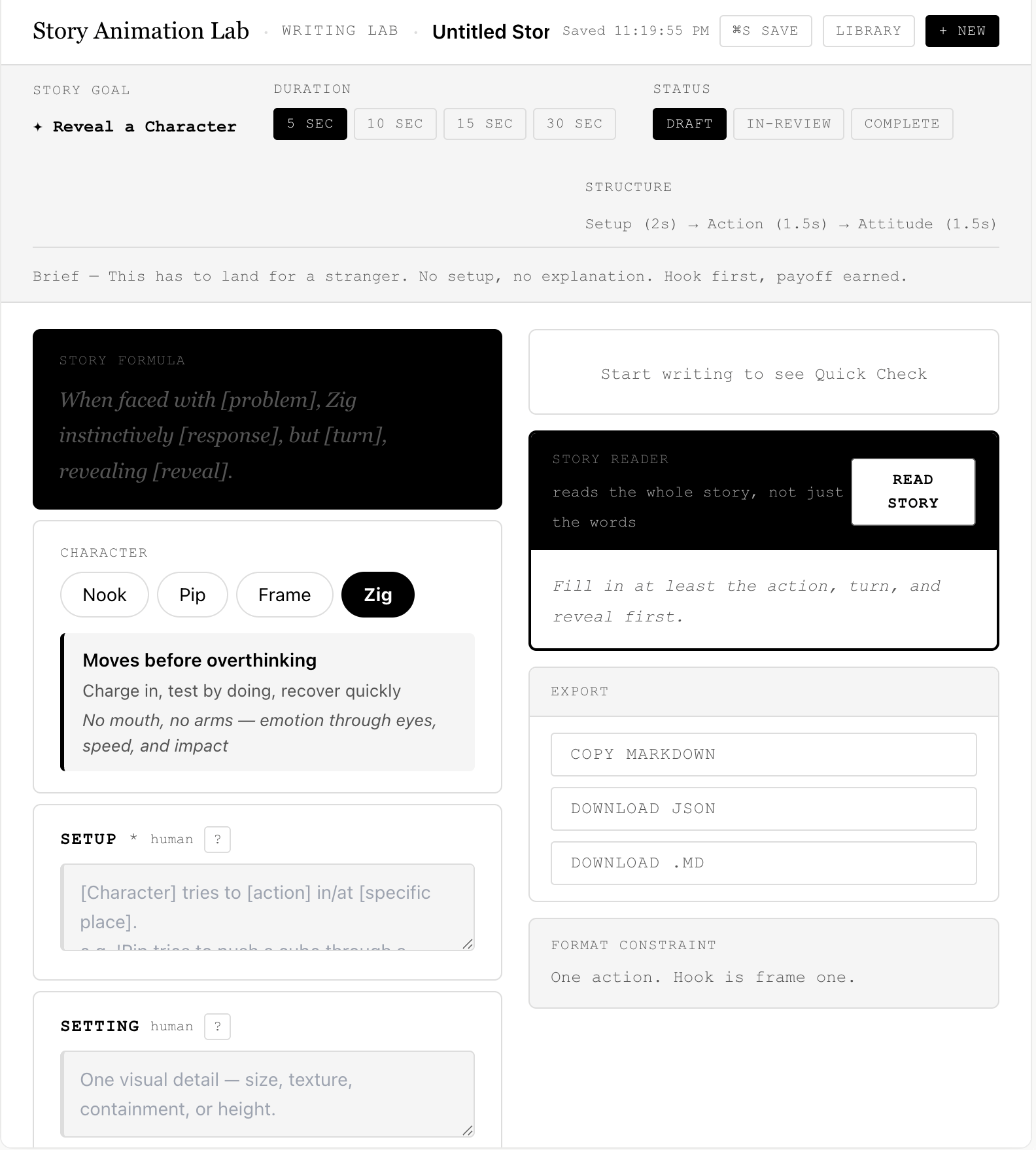
Which, honestly, was the pattern showing up again.
A very me kind of pattern, if I am honest.
I got excited by the system before proving the smallest version by hand.
So I am backing up.
Before I keep building the tool, I need to test the story system manually.
Obvious in hindsight. Still important.
So this is me keeping myself in check: do not rush to output something when the story is not there yet.
The story should not be shortcut either.
This is where the human in the loop is the most important.
There is also a real self-awareness in all of this.
I have spent most of my career focused on the look of the thing. Look development, lighting, compositing, mood, and final image. My job was to help the story feel as good as possible visually.
But the story was usually already there.
So this part is outside my box.
And honestly, that is what makes it exciting.
This new creative moment makes me feel a little like I am back in grad school, when I had to own the whole thing end to end. The idea, the story, the visuals, the execution, the problem-solving.
It is exhilarating.
For creatives who have spent a long time inside one specialized part of the pipeline, these tools can reopen the whole playground.
Suddenly, I am not only asking, “How do I make this look better?”
I am asking, “What do I want to make?”
And that is the part that feels exciting …
This week I made. That’s the point, really. Not that it was perfect or even that it worked, but that I kept making.